
Notwithstanding India's protests, the Obama administration is readying itself to provide Pakistan with even more massive doses of military largesse, as senior United States officials acknowledged that Pakistan's request for additional security assistance would be a top priority on the agenda of the US-Pakistan Strategic Dialogue that begins on Wednesday.

Guterres said in Islamabad that he was concerned over the situation in Kashmir, and that he was ready to mediate between India and Pakistan to resolve the long pending issue.

The All India Tennis association (AITA), taking a more aggressive stance than earlier, said it would not request for a neutral venue for the Asia Oceania Zone 1 tie on September 14-15 as is being asked by the International Tennis Federation (ITF).

Chinese Foreign Minister Wang Yi arrived in India Thursday evening in the highest-level visit between the two countries after the ties came under severe strain following the eastern Ladakh standoff nearly two years ago.

Underworld don Dawood Ibrahim, speedy trial of 26/11 Mumbai terror attack and capture of a Pakistani terrorist in Udhampur are some of the key issues to be raised by India at the forthcoming NSA-level talks with Pakistan.

He said India has been maintaining that terror and talks cannot go together, but talks on terror can definitely go ahead.

"We will soon find out. I'm in no rush. There's no testing... If you look at the end of the Obama administration, it was a disaster. What was going on. You don't have that right now. It's a much different feeling. I think people have...there's always danger, but I think people have much different feeling," he said.

Pakistan on Friday "regretted" India's virtual rejection of its proposal for talks on Kashmir even as it briefed the ambassadors of the P-5 and European Union countries about the situation there in yet another attempt to internationalise the issue.
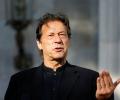
"The letter stated that the no-confidence motion was being tabled even before it was filed, which means the Opposition was in contact with them," Khan alleged in his address to the nation.
The structural trends in Pakistan raise the possibility that the army's opinions may increasingly have to parallel, not shape, the public's, says Ajai Shukla

Pakistan has accused India of sabotaging peace efforts and putting the regional security and stability at stake by objecting to include Kashmir issue in the bilateral dialogue.
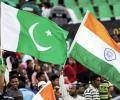
India and Pakistan in a surprise announcement said on February 25 that they have agreed to strictly observe all agreements on ceasefire along the Line of Control in Jammu and Kashmir and other sectors.

Since the 1984 national elections, no party has won a clear majority in the lower house of Parliament, a US intelligence report has observed. Vicky Nanjappa reports.

The attempt failed as other member countries felt Kashmir is a bilateral matter between India and Pakistan.
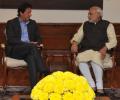
In a statement, the MEA said, "The latest brutal killings of our security personnel by Pakistan-based entities and the recent release of a series of 20 postage stamps by Pakistan glorifying a terrorist and terrorism confirm that Pakistan will not mend its ways."
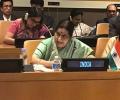
MEA spokesperson Raveesh Kumar said at a media briefing that the meeting, however, does not indicate any change in India's policy towards Pakistan.
Despite the failure to ink the agreement on a new liberalised visa regime, India and Pakistan on Friday said that home secretary-level talks in Islamabad were fruitful.

External Affairs Ministry Spokesperson Raveesh Kumar also talked about the China-Pakistan economic corridor in Pakistan-occupied-Kashmir, asserting that India is 'resolutely opposed' to any actions by other countries to change the status quo in the region.
Pakistan has said it could focus on American demands to do more in the war on terror only if the US used its influence with India to lessen tensions and to press for resumption of the stalled composite dialogue process.
'Any 'de-escalation' that brings down tensions will deprive the BJP of a plank with seamless possibilities to project PM Modi as the 'Iron prime minister' and hype up jingoism in the upcoming election campaign,' notes Ambassador M K Bhadrakumar.

A closure of the Indian mission in Kabul will be a Himalayan blunder at this historic juncture when the wheels of diplomacy and politics are set to accelerate in Afghanistan, argues Ambassador M K Bhadrakumar

India is actively considering the Pakistani proposal on the talk schedule for remaining secretary-level meetings in the third round of resumed dialogue with dates on the crucial issue of water and Sir Creek being suggested ahead of the meeting between their prime ministers in New York in September.
Majority of the 15 members said there should not be any statement or outcome issued after the consultations and their will prevailed, leaving China to come out and make a statement in its national capacity followed by Pakistan.

With the Afghanistan government in Kabul approaching Islamabad for help in opening "reconciliation" talks with the Taliban, a Pakistani role in shaping the political landscape in Afghanistan is now an uncomfortable likelihood for New Delhi.

The Indian Army conducted surgical strikes on terror launch pads across the Line of Control on September 29 two years ago.
Some members of the Obama administration have worried that Pakistan's heightened anxieties about India might lead Islamabad to take reckless measures, so they have wanted New Delhi to pursue more diplomatic engagement with Islamabad.

In the past, India strongly rejected references made to Jammu and Kashmir in a previous joint statement by Pakistan and China.

The external affairs minister also said that Pakistan openly practises terrorism and there is no scope for negotiations until Islamabad reins in its financing and recruitment of militant groups.

The prospect of a civil nuclear deal with Pakistan being talked about in the public domain is quite unlikely, the White House said, but acknowledged that the United States is in talks with Islamabad on issues related to nuclear safety and security.
The Pakistan government believes Indian Prime Minister Manmohan Singh should back up his call for re-engagement with concrete measures aimed at addressing key outstanding issues like the Kashmir dispute and security concerns, diplomatic sources said on Wednesday.

Khan claimed he was informed by late prime minister Atal Bihari Vajpayee and former foreign minister Natwar Singh during a conference that Kashmir would have been resolved if the BJP had not lost the 2004 Lok Sabha elections.

Amid the see-sawing developments of dialogue between India and Pakistan, Foreign Secretary S. Jaishankar said on Wednesday that New Delhi's priority would be action over talks in the aftermath of the deadly Pathankot terror attack.
The nation has been put on high alert following intelligence inputs that Pakistan-based terrorists, who are against any thaw in Indo-Pak relations, may strike in a desperate bid to derail the South Asian Association for Regional Cooperation meeting in Islamabad.Sources said the advisory issued by the ministry of home affairs has asked all states to maintain increased vigil and take precautionary measures to ensure security.

There is growing acceptance of the idea in the international community that engaging the Taliban government is a far better approach than ostracising it, observes Ambassador M K Bhadrakumar.

The talks between Singh and Esper came a day after Prime Minister Narendra Modi held a telephonic conversation with US President Donald Trump.
The independent task force set up last year included Richard Holbrooke, the Special US Representatives for Pakistan and Afghanistan, and General James Jones, National Security Advisor. But both of them stepped down from the task force before the first draft was written, and as such they are not associated with the report, it says.

A deft hand on India-China relations, Bambawale earlier handled the China desk at the MEA.

Prime Minister Modi told President Xi that he has made efforts to improve ties with Islamabad but these efforts have been "derailed".

Australian Foreign Affairs Minister Marise Payne also urged India and Pakistan to "exercise restraint" and engage in dialogue to ensure issues are resolved peacefully.
 © 2026 Rediff.com - Advertise with us - Disclaimer - Privacy Policy - Sitemap - Feedback - About us - Terms of use - Grievances